
Tekkonkinkreet Director & Writer Discuss Anime Movie’s Legacy, 4K Release
Tekkonkinkreet director Michael Arias and writer Anthony Weintraub spoke with ComingSoon’s Tyler Treese about the iconic anime movie. The duo discussed its legacy, their approach to adaptation, and its new 4K release. GKIDS’ 4K rerelease is now playing in theaters.
“Black, a boy who seeks to bend the city to his will through strength, and White, his innocent counterpart, are two orphaned street kids living in the slums of Treasure Town. When real estate developers threaten to transform Treasure Town into a massive theme park, its very existence is put at risk. Determined to protect both White and their city, Black takes on the yakuza and assassins, gradually losing his innocence as he confronts a dark manifestation within himself,” reads the official synopsis of Tekkonkinkreet.
Tyler Treese: Michael, I was curious: what kind of involvement does a director have when something like this occurs? Are you approving the remaster grading changes, or how does that process work?
Michael Arias: Well, first of all, GKIDS has a lot of experience working with a wide range of animation studios, from Studio Ghibli on down. They’ve been through this process many times, so I really relied on the GKIDS technical team to guide me through it.
There was also a certain amount of digging around for old files. It’s been a long time. Fortunately, everything was very well preserved. Our main sources were the original Blu-ray masters, which were already pristine from the original digital files, along with the original files themselves. We had the best source material we could possibly get.
It was really a matter of bringing everything up to modern specifications with 4K HDR and so on. On my end, I looked at the film with fresh eyes and did a bit of quality control. When you sit in a dark room looking at something for days, you really start to see between the pixels. I wanted to get it right because I feel like this is our archival version of Tekkonkinkreet. I don’t expect to be doing this again, so I really wanted it to be definitive.
I also felt that the initial release back in 2006 and 2007 didn’t reach a very large audience, especially outside Japan, and it often wasn’t seen under the best conditions. We were showing it on 35mm CinemaScope prints, and I really wanted people to be able to see it the way I saw it in the studio — in a pristine environment.
That became my guiding principle. Thanks to GKIDS not only for helping me get there, but also for working with all the rights holders and making this release happen. They’ve been amazing partners.
I’m just so glad to have this opportunity. How often does a film get a second life 20 years later? A whole new generation gets to see it, and a lot of people who only saw it at home can finally experience it properly on the big screen. That’s incredibly exciting for me.
Anthony, I was curious: how did you originally come across this manga, and what made you want to adapt it? We don’t see many American writers faithfully adapting manga for the screen. What led you to this project?
Anthony Weintraub: It was really Mike who introduced me to the material and brought me onto the project, so perhaps it was his crazy idea.
We had worked together before on The Animatrix, and I was certainly interested in this kind of material. I was a comic-book geek growing up, and I became fascinated by Japanese animation, live-action films, and the culture in general. So in some ways, it was already part of my DNA.
But ultimately, it came down to the same question every writer asks when approaching an adaptation: Do I relate to the material, and do I think I can contribute something meaningful? I was completely blown away by Taiyo Matsumoto’s work. The themes were so powerful, and I wanted to take a shot at adapting something that was potentially very challenging because of its scale and complexity.
Someone asked Mike earlier about being a Westerner making animation in Japan. Honestly, I don’t think either of us spent much time thinking about that. What we thought about was getting the chance to work with extraordinary material alongside incredible collaborators.
The distinction of being one of the few Westerners involved wasn’t nearly as important as the opportunity to work with something Taiyo Matsumoto created. You don’t get precious about those things. You just try to be worthy of the work.
Yeah, great art is ultimately what’s going to be the lasting legacy, regardless of any “firsts.” It all comes down to whether the work resonates with people.
Michael, I watched the film again this morning, and one thing that really stood out is how much the city feels like a character. Could you talk about your mindset in making the city so distinct? It has these wonderful cityscapes, but every part of it feels vibrant and alive. It’s such a huge part of the movie.
Michael Arias: Thanks for saying that. That means a lot.
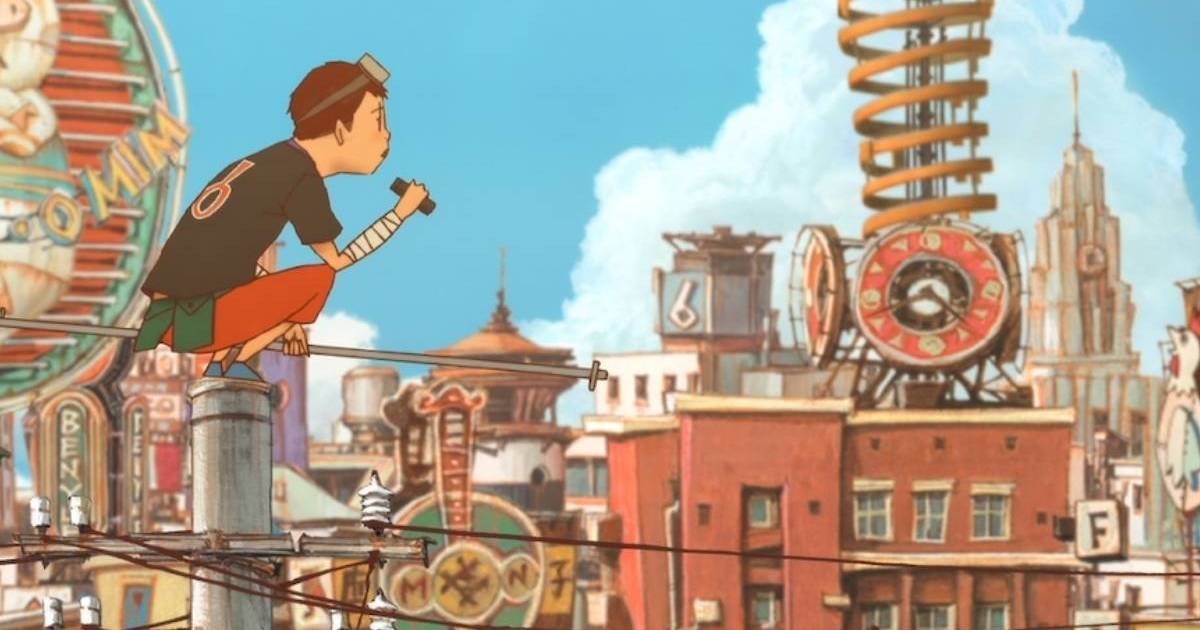
One of the concepts Anthony and I shared was that we didn’t want this to be only the story of these kids fighting the Yakuza and real-estate developers. We wanted it to be the story of both the kids coming of age and the city itself coming of age—transforming and evolving.
The first challenge I gave our art director, Shinji Kimura, was that I wanted the city to be the star of the movie. He really took that to heart. I think while he was painting the backgrounds, he was determined to make them so compelling that they’d almost overshadow the characters. There was this playful tension between the animation team and the background team over who would get the spotlight.
I think it worked. You’re always aware of where you are and how the spaces connect. When Black and White move through the city, you understand exactly where they’ve been and how those locations relate to one another. Everything was intentional.
The city was designed not only to create a mood but also to support the story of a place that’s decaying while something almost like a virus or cancer grows at its center. These forces are trying to reshape the city into something of their own.
A lot of my job involved feeding the art department references. I’d find an interesting fire hydrant in Hong Kong and say, “Let’s put these everywhere.” Or I’d find signage from Sri Lanka. I wanted the city to feel organic and endlessly interesting, like a pile of toys spilled across the floor where your eye lands on something different every time you look.
I hope that comes across, and honestly, it comes across even better in 4K on a big screen.
Anthony, you spoke with such reverence for the source material. Could you talk about your general approach to adaptation? How do you decide what to expand, what to change, and what absolutely needs to stay?
Anthony Weintraub: It’s not that different from most adaptations. You’re trying to identify the core themes and emotional ideas that make the material resonate. Then you ask: What is the best structure to communicate those ideas in a film?
We had an incredible wealth of material in the three volumes Taiyo wrote. A lot of the work involved distilling the essential themes surrounding the two main characters and their relationship. It’s not hard to notice all the other character pairings throughout the story. They function as part of the scaffolding that supports the central narrative. Taiyo does that beautifully.
Every subplot serves the larger story in some way. The challenge was figuring out which elements Mike and I loved most and which elements we could let go of—not because they weren’t valuable, but because they weren’t necessary for this particular film.
Eventually, you have to set the manga aside and make a movie. That’s when the real fun begins. But ultimately, it’s always about staying true to the feelings and emotions of the original work. That’s what I respond to when I’m adapting something.
Michael, the film won the Japan Academy Prize for Animation of the Year and was embraced fairly quickly in Japan. In America, though, it seemed to build its audience more gradually through word of mouth and a passionate cult following. What has it been like seeing the community continue to embrace the film over the years and watching the fan base steadily grow?
Arias: It’s great to hear you say that. I honestly only recently became aware that Tekkonkinkreet had developed a cult following outside Japan. I discovered it through an art director I’m currently working with who’s about ten years younger than I am.
Every now and then, I’d reference something from Tekkonkinkreet, and he told me that his love for the film was actually one of the reasons he wanted to work with me. My assumption had always been that outside Japan, the movie was largely unknown. It only played in a handful of theaters in 2007 and appeared at a few festivals.
I felt that while the world had moved on, a lot of the work we did on the film was ahead of its time and had held up remarkably well. I mentioned that to him, and he said, “What are you talking about? Every kid who went to art school after Tekkonkinkreet came out knows this movie.”
He told me that for many artists and animators in North America and Europe, it’s practically a bible. That surprised me. But the more I looked into it, the more I realized there really is a generation of artists and animation students who found the film somehow—through a dorm room screening, an old DVD, BitTorrent, a college film series, whatever it might have been.
The fact that it has spoken to people, especially within creative communities, feels wonderful. Honestly, we should already be grateful just to have the opportunity to make films like this. That’s a gift in itself. But to have something continue to resonate 20 years later is incredibly special. In some ways, I don’t even think of it as my movie anymore. It has a life of its own. It’s out there walking around, connecting with new people and meaning something to them. That’s a real joy.
Thanks to Michael Arias and Anthony Weintraub for taking the time to talk about Tekkonkinkreet.
Source: Comingsoon.net