
Disclosure Day Review: Steven Spielberg’s Magnificent Sci-Fi Movie
There’s something uniquely special about sitting in a theater in 2026, seeing the Universal logo give way to an Amblin production, hearing a new John Williams score swell through the speakers, and knowing you’re about to watch a brand-new Steven Spielberg film. We won’t always have moments like this. Spielberg and Williams have spent decades creating some of the most beloved films in cinema history, and every new collaboration feels like an event. With Disclosure Day, Spielberg delivers one of his darker and more ambitious films in years—a conspiracy thriller that blends extraterrestrial mystery, high-stakes action, and philosophical questions about truth, faith, and humanity’s place in the universe.
Unlike many films that spend an hour building toward a major revelation, Disclosure Day begins as if it has already reached the third act. The movie opens with Daniel (Josh O’Connor), a whistleblower in possession of information that powerful people desperately want to keep hidden. A loved one has been kidnapped, shadowy operatives are closing in, and Daniel is immediately forced into survival mode. Spielberg wastes no time establishing the stakes. From the opening scenes, the film throws viewers into a world of paranoia and danger, creating a sense of urgency that rarely lets up.
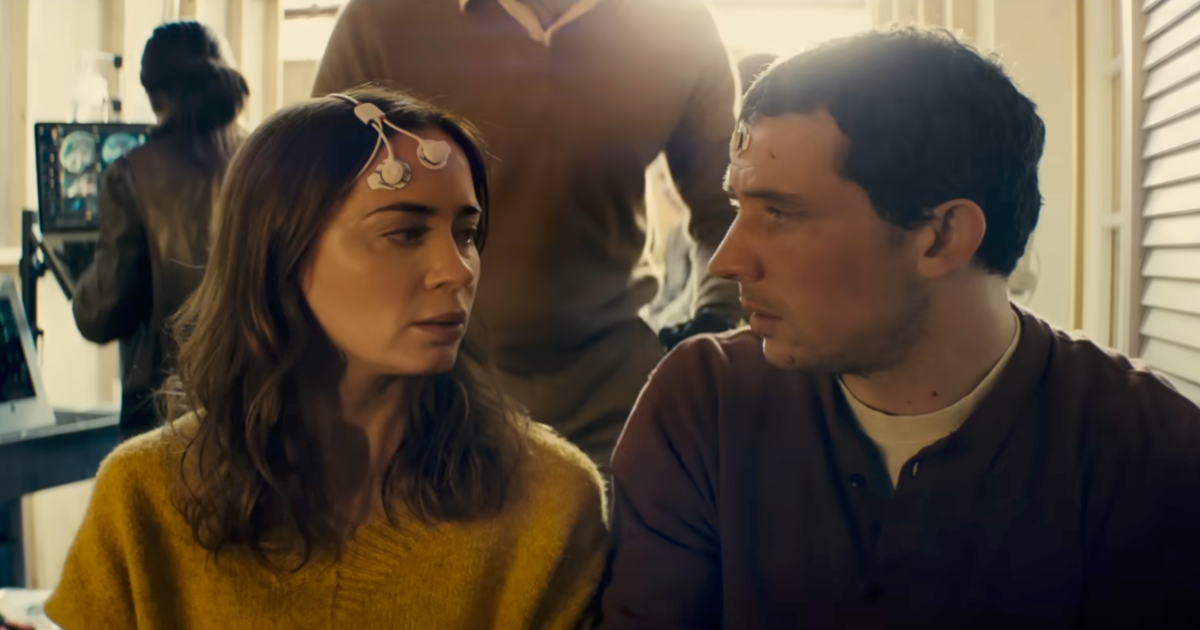
Daniel is carrying evidence that could fundamentally change humanity’s understanding of reality, and much of the film revolves around his efforts to protect that information while evading an organization determined to recover it. The story frequently alternates between Daniel’s storyline and that of Margaret Fairchild (Emily Blunt), a meteorologist whose life takes a bizarre turn when she begins speaking languages she has never learned. Even more unsettling, she starts gaining impossible insights into the strangers around her, somehow becoming aware of deeply personal truths she could not possibly know.
Spielberg directs both storylines with the confidence and precision that have defined his career. His blocking remains impeccable, and his camera movements are often so fluid and natural that viewers may not consciously notice how much craftsmanship is involved. He stages scenes with remarkable clarity, allowing the audience to remain fully engaged in the story rather than drawing attention to technique. Many of the film’s most impressive shots unfold in extended takes that quietly showcase Spielberg’s mastery of visual storytelling.
At its core, Disclosure Day is about the possibility that extraterrestrial life is real and the consequences of revealing that truth to the world. The film functions as a conspiracy thriller first and a science-fiction film second, which helps ground its more fantastical ideas. Spielberg and screenwriter David Koepp construct a story centered on secrecy, suppression, and the immense power that comes with controlling information. The result is a suspenseful narrative that often feels like a political thriller infused with cosmic wonder.
The action sequences are among the film’s highlights. One particularly impressive car chase demonstrates Spielberg’s enduring ability to stage practical vehicular action. Ever since Duel, he has understood how to generate suspense through movement and geography, and that expertise remains fully intact here. The sequence is thrilling not because of excessive visual effects but because Spielberg understands exactly where to place the camera and how to maintain a clear sense of space and momentum. The chase feels dangerous and tangible in a way that many modern action films struggle to achieve.
Emily Blunt delivers some of the film’s strongest material. Margaret’s storyline requires her to carry much of the emotional weight, balancing personal trauma with increasingly inexplicable supernatural experiences. Blunt convincingly portrays a woman trying to understand forces beyond her comprehension while still remaining grounded in recognizable human emotions. Her performance gives the film a crucial emotional anchor amid its larger cosmic questions.
One of the movie’s most fascinating elements is its exploration of how humanity might react if undeniable proof of a higher intelligence emerged. Spielberg doesn’t simply treat disclosure as a scientific event; he examines its moral, philosophical, and religious implications. What happens when people who have spent their lives searching for spiritual meaning are suddenly confronted with evidence that reshapes their understanding of existence? The film raises these questions without offering easy answers, allowing viewers to wrestle with the implications themselves.
This thematic focus feels like a natural extension of Spielberg’s lifelong fascination with extraterrestrials. Throughout his career, he has explored alien life through vastly different lenses, whether in Close Encounters of the Third Kind, E.T. the Extra-Terrestrial, War of the Worlds, or even Indiana Jones and the Kingdom of the Crystal Skull. Disclosure Day represents perhaps his most direct attempt to examine what actual disclosure might mean for modern society. While the film incorporates science-fiction concepts involving invisibility and other extraordinary phenomena, it remains surprisingly grounded because its central concern is not aliens themselves but humanity’s response to the truth.
Colin Firth serves as the film’s primary antagonist, portraying a man determined to preserve decades of secrecy. While he is unquestionably an obstacle to the protagonists, the screenplay wisely avoids reducing him to a simple villain. His motivations are understandable, even when his methods are not. Firth brings intelligence and conviction to the role, creating an adversary whose perspective adds complexity to the film’s central conflict.
Not everything works perfectly. Koepp’s screenplay is packed with ideas, and there are moments when those ideas don’t fully cohere. The film juggles conspiracy elements, emotional drama, science-fiction concepts, religious questions, and action-thriller mechanics, sometimes struggling to balance them all. The third act is especially ambitious, reaching for profound emotional and philosophical conclusions. While much of it is undeniably impressive, there were moments when I wished the story had embraced a more relatable, grounded resolution rather than leaning into its more fantastical instincts.
The supporting cast also feels somewhat underutilized. Eve Hewson, as Daniel’s girlfriend Jane Blankenship, has several compelling scenes early in the film, but her role becomes less significant as the narrative increasingly focuses on the connection between Daniel and Margaret. The emotional foundation established between Daniel and Jane is strong enough that it feels like there was room to explore their relationship more deeply. And while the film is filled with character-building moments, not all of them land with that much force.
Even with these shortcomings, Disclosure Day remains a compelling and thought-provoking experience. It is a film filled with big ideas, thrilling action, and genuine wonder. Spielberg once again demonstrates why he remains one of cinema’s greatest storytellers, crafting a movie that is both entertaining and intellectually engaging. It may not rank among his absolute masterpieces, but it stands as another impressive late-career achievement from a filmmaker who continues to challenge himself while exploring themes that have fascinated him for decades. For audiences who love science fiction, conspiracy thrillers, or simply the experience of watching Spielberg work at the height of his powers, Disclosure Day is a journey worth taking.
SCORE: 8/10
As ComingSoon’s review policy explains, a score of 8 equates to “Great.” While there are a few minor issues, this score means that the art succeeds at its goal and leaves a memorable impact.
Disclosure: ComingSoon attended a press screening for our Disclosure Day review.
Source: Comingsoon.net